


Apr 22, 2026 





In 2026, the autonomous driving industry is entering a critical phase of mass adoption, with automakers, tech giants, and mobility startups racing to deploy safe, reliable self-driving vehicles (SDVs) across global markets. Yet, one fundamental challenge remains the bottleneck for progress: access to high-quality, diverse, and compliant autonomous driving data. The performance, safety, and scalability of self-driving systems depend entirely on the driving datasets used to train their AI models—from real-world road scenarios to edge cases that could mean the difference between safe operation and catastrophic failure. This blog explores the 2026 autonomous driving data industry landscape, highlights key trends reshaping how organizations source and use self driving car dataset solutions, and outlines how Keycore stands out as a leader in delivering tailored autonomous driving dataset services that solve the industry's most pressing data challenges.
The global autonomous driving market is projected to grow at a CAGR of 35% through 2030, according to a 2026 industry report by McKinsey—but this growth is contingent on access to high-quality autonomous driving data. Self-driving AI models require massive volumes of data to learn how to navigate complex road environments, interpret traffic signals, react to unexpected obstacles, and adapt to diverse weather and lighting conditions. Generic or low-quality driving datasets lead to models that struggle in real-world scenarios, increasing the risk of accidents and delaying deployment. For organizations investing in autonomous driving, the right self driving car dataset is not just a resource—it's a strategic asset that determines competitive advantage.
A high-quality autonomous driving dataset is not defined by data volume alone. Its value depends on whether the collected data represents the conditions in which the vehicle is expected to operate and whether the annotations provide reliable ground truth for the target perception or prediction task.
For ADAS and autonomous driving development, dataset quality should normally be evaluated across several dimensions:
| Dataset Dimension | What Should Be Evaluated | Why It Matters |
|---|---|---|
| Scenario coverage | Urban roads, highways, intersections, construction zones and other target environments | Helps the model generalize beyond repetitive driving conditions |
| Environmental diversity | Day, night, rain, fog, glare and changing weather | Reduces performance gaps under difficult sensing conditions |
| Sensor coverage | Camera, LiDAR, radar, GPS/IMU or other project-specific sensors | Determines whether the dataset supports the intended perception architecture |
| Annotation consistency | Class definitions, object boundaries, 3D geometry and temporal labels | Provides dependable ground truth for model training and evaluation |
| Edge-case coverage | Rare road users, unusual behaviour, occlusion and unexpected events | Helps address situations that may be poorly represented in routine driving data |
| Data traceability | Collection source, processing history, annotation version and quality records | Makes datasets easier to validate, audit and update |
This means automotive AI teams should evaluate a driving dataset against their operational design domain, sensor configuration and model objectives rather than selecting data based only on the number of images, frames or driving miles.
For example, a large dataset dominated by clear daytime highway driving may still provide limited value to a model intended for dense urban intersections or adverse-weather conditions.
In 2026, three key trends are reshaping the autonomous driving data landscape, creating both opportunities and challenges for industry players. First, the demand for diverse, scenario-rich autonomous driving dataset solutions is skyrocketing. As self-driving vehicles move beyond controlled test environments and into urban, suburban, and rural areas, AI models need autonomous driving data that covers a wide range of scenarios: busy city intersections, narrow rural roads, construction zones, and extreme weather conditions (rain, snow, fog). Generic driving datasets that focus on basic highway scenarios are no longer sufficient—organizations need tailored data that reflects the unique challenges of their target markets.
Second, regulatory pressure is increasing, making compliance a non-negotiable for autonomous driving data collection and use. Governments worldwide are implementing strict regulations to protect privacy (e.g., GDPR, CCPA) and ensure the safety of self-driving systems. For example, the EU's Autonomous Vehicle Regulation requires that driving datasets used to train SDVs are collected ethically, with proper consent from pedestrians and other road users, and that data is stored and processed in compliance with privacy laws. This has made it increasingly difficult for organizations to collect real-world self driving car dataset solutions on their own, as they lack the infrastructure and expertise to navigate complex regulatory requirements.
Third, the rise of Level 4 and Level 5 autonomous vehicles has increased the need for edge-case autonomous driving data. These advanced systems must handle rare but critical scenarios—such as a pedestrian darting into the road, a vehicle suddenly swerving, or a road sign being obscured by debris—that are rarely captured in standard driving datasets. Without access to these edge cases, AI models cannot be trusted to operate safely in all real-world scenarios. This has led to a growing demand for autonomous driving dataset solutions that combine real-world data with synthetic data to fill gaps and ensure comprehensive model training.
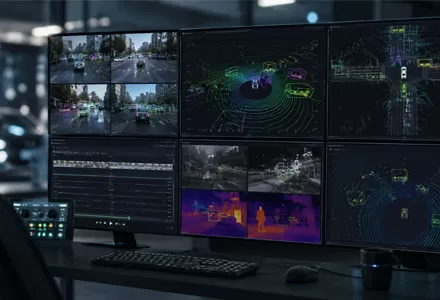
The composition of an autonomous driving dataset depends on the vehicle's sensing architecture and the AI functions being developed. Camera, LiDAR and radar data provide different types of information, while multi-sensor systems often require these inputs to be synchronized and interpreted together.
| Data Type | Common AI Tasks | Typical Training Requirements |
|---|---|---|
| Camera images and video | Object detection, lane recognition, traffic sign recognition and semantic segmentation | 2D bounding boxes, polygons, segmentation masks, lane lines and object tracking |
| LiDAR point clouds | 3D object detection, distance estimation and spatial perception | 3D cuboids, point-cloud segmentation, object classes and spatial coordinates |
| Radar data | Distance, speed and motion detection | Object association, velocity information and sensor-aligned labels |
| Multi-sensor sequences | Sensor fusion, object tracking and trajectory prediction | Time synchronization, calibration, cross-sensor object matching and temporal consistency |
| In-cabin data | Driver monitoring, occupant detection and human-machine interaction | Face, gesture, posture, gaze or speech-related annotations depending on the application |
For projects using several sensor modalities, data quality is not limited to the accuracy of each individual annotation. Sensor fusion annotation also requires consistent timestamps, coordinate systems and object identities across the available sensor streams.
If the same road user is represented differently across camera, LiDAR and radar data, inconsistent ground truth can introduce additional noise into the training pipeline. This is why sensor synchronization and cross-modal consistency should be considered during dataset planning rather than checked only after large-scale annotation has been completed.
Despite these trends, many organizations in the autonomous driving space still face significant challenges when it comes to autonomous driving data. A 2026 survey by the Autonomous Vehicle Industry Association (AVIA) found that 72% of automakers and mobility startups struggle to source driving datasets that are both diverse and compliant. Many generic data providers offer one-size-fits-all self driving car dataset solutions that lack the scenario-specific data needed for target markets, leading to AI models that underperform in real-world tests. Additionally, 65% of organizations cite high costs and resource constraints as barriers to collecting and annotating their own autonomous driving dataset solutions. This is where Keycore's unique approach to autonomous driving data sets us apart from competitors.
Keycore's leadership in the autonomous driving data space stems from our deep industry expertise, unwavering focus on quality, and commitment to customization—three areas where many providers fall short. Unlike generic data vendors, we specialize exclusively in delivering driving datasets tailored to the unique needs of autonomous driving systems, from Level 2 advanced driver assistance systems (ADAS) to Level 5 fully autonomous vehicles. Our team of data scientists, automotive experts, and annotation specialists works closely with clients to understand their target markets, model requirements, and regulatory needs, ensuring that every self driving car dataset we deliver is relevant, accurate, and compliant.
One of Keycore's key advantages is our ability to deliver diverse, scenario-rich autonomous driving dataset solutions. We operate a global network of data collection vehicles equipped with state-of-the-art sensors (LiDAR, cameras, radar, and GPS) that capture high-resolution autonomous driving data across 50+ countries. Our driving datasets cover a wide range of scenarios: urban centers with complex intersections, suburban neighborhoods, rural roads, highways, and extreme weather conditions. We also collect data across different times of day (daylight, dusk, night) and traffic conditions (peak hours, low traffic, construction zones), ensuring that AI models are trained to handle every real-world scenario.
Compliance is another area where Keycore outperforms competitors. We understand the strict regulatory requirements governing autonomous driving data, and our data collection and processing processes are designed to meet GDPR, CCPA, and regional regulations worldwide. Our self driving car dataset solutions are collected with explicit consent from road users, and we implement strict data anonymization techniques to protect privacy. We also maintain detailed audit trails for all autonomous driving dataset solutions, making it easy for clients to demonstrate compliance during regulatory audits. This level of compliance has made Keycore the trusted partner for organizations operating in highly regulated markets, including the EU, North America, and Asia.
Keycore's commitment to quality is evident in our rigorous data annotation and validation processes. Autonomous driving data is only valuable if it is accurately annotated—every object (pedestrians, vehicles, traffic signs, road markings) must be labeled with precision to ensure AI models can interpret the environment correctly. Our team of expert annotators uses advanced tools and proprietary techniques to annotate driving datasets with pixel-level accuracy, and we implement multiple rounds of validation (manual and automated) to eliminate errors. This ensures that our self driving car dataset solutions are reliable and consistent, helping clients build AI models that perform safely and accurately in real-world scenarios.
Scalability is another critical advantage of Keycore's autonomous driving dataset services. As autonomous driving initiatives grow, organizations need driving datasets that can scale with their needs—from small pilot datasets to large-scale enterprise solutions. Keycore's cloud-native data platform allows us to deliver autonomous driving data at scale, whether a client needs 10,000 miles of annotated road data for a pilot model or 100,000 miles for a full-scale deployment. We also offer flexible delivery options, allowing clients to access self driving car dataset solutions on-demand, reducing storage costs and improving efficiency.
To illustrate the impact of Keycore's autonomous driving data solutions, let's look at two real-world client success stories. A leading global automaker was developing a Level 4 autonomous vehicle for urban markets but struggled with driving datasets that lacked diversity in urban scenarios. Generic data focused on highways, leading to their AI model failing to navigate complex city intersections and pedestrian-heavy areas. After partnering with Keycore, we delivered a tailored autonomous driving dataset that included 50,000 miles of urban road data, covering busy intersections, pedestrian crossings, and construction zones. Our self driving car dataset also included edge cases like sudden pedestrian movements and vehicle lane changes. The result? The automaker's AI model achieved 98% accuracy in urban navigation tests, a 40% improvement from their previous dataset, and they were able to accelerate their deployment timeline by 18 months.
Another example comes from a mobility startup developing an ADAS system for commercial trucks. The startup needed autonomous driving data that focused on long-haul highway scenarios, including night driving, inclement weather, and heavy traffic. They initially used generic driving datasets that were designed for passenger cars, leading to poor performance in truck-specific scenarios. Keycore’s team worked closely with the startup to develop a custom autonomous driving dataset that included truck-specific data: large vehicle blind spots, long braking distances, and highway merging scenarios. Our self driving car dataset (tailored for commercial trucks) also included data from different geographic regions, ensuring the ADAS system could adapt to varying road conditions. The result was a 35% reduction in false alerts, a 28% improvement in collision avoidance, and the startup secured $50 million in funding to scale their solution.
In 2026, as the autonomous driving industry continues to evolve, Keycore remains at the forefront of innovation. We are constantly expanding our global data collection network, refining our annotation techniques, and integrating synthetic data into our driving datasets to fill edge-case gaps. Our autonomous driving data solutions are designed to integrate seamlessly with all types of self-driving AI models, from ADAS to fully autonomous systems, making us a one-stop partner for organizations looking to accelerate their autonomous driving deployment.
Before selecting an existing dataset or commissioning a custom AI data collection project, automotive AI teams should evaluate whether the data matches the model task, operating environment and sensor architecture.
| Evaluation Area | Key Question |
|---|---|
| Model task | Does the dataset support perception, tracking, prediction or sensor fusion requirements? |
| Scenario coverage | Are the required road types, traffic conditions, weather and lighting represented? |
| Sensor configuration | Does the dataset match the camera, LiDAR, radar or other sensors used by the project? |
| Annotation quality | Are label definitions, geometric accuracy and review procedures clearly documented? |
| Temporal consistency | Are object identities and labels consistent across consecutive frames? |
| Edge-case coverage | Are known model failure scenarios sufficiently represented? |
| Data provenance | Is the source and permitted use of the data documented? |
| Delivery format | Can the dataset integrate efficiently with the existing training pipeline? |
Evaluating these factors before large-scale training can help teams identify coverage gaps early and reduce rework caused by incompatible annotations, missing scenarios or inconsistent sensor data.
When you choose Keycore for your autonomous driving dataset needs, you benefit from:
Tailored Driving Datasets: Our self driving car dataset solutions are customized to your target market, model level, and specific use cases, ensuring maximum relevance and performance.
Uncompromising Quality: Rigorous annotation and validation processes ensure our autonomous driving data is accurate, reliable, and consistent.
Full Regulatory Compliance: Our driving datasets meet GDPR, CCPA, and regional regulations, eliminating privacy and legal risks.
Global Scalability: Cloud-native infrastructure allows us to deliver autonomous driving dataset solutions of any size, from pilot to enterprise scale.
Expert Industry Support: Our team of automotive and data experts provides end-to-end guidance, from dataset design to integration into your AI workflows.
As the 2026 autonomous driving industry moves toward mass adoption, the quality of autonomous driving data will be the defining factor in success. Generic driving datasets will no longer be sufficient—organizations need tailored, high-quality self driving car dataset solutions that reflect real-world scenarios and meet regulatory requirements. Keycore's proven approach to autonomous driving data ensures that our clients stay ahead of the curve, building safe, reliable self-driving systems that accelerate deployment and drive industry innovation.
Whether you're developing an ADAS system, a Level 4 autonomous vehicle, or a commercial trucking solution, Keycore has the expertise and technology to deliver the autonomous driving dataset you need to succeed. We're committed to providing autonomous driving data that drives real business value, helping you unlock the full potential of self-driving technology in 2026 and beyond.
Contact Keycore today to learn how our tailored driving datasets and self driving car dataset solutions can accelerate your autonomous driving deployment and help you stay ahead in the competitive global market.
Autonomous driving systems may use camera images and video, LiDAR point clouds, radar, GPS/IMU data and other sensor inputs depending on the system architecture. Training data can also require bounding boxes, segmentation, 3D cuboids, object tracking, lane annotation, trajectories and cross-sensor associations.
A high-quality autonomous driving dataset should reflect the model's target operating environment, contain sufficient scenario and environmental diversity, maintain consistent ground truth and include difficult or underrepresented situations that are relevant to model performance.
Common methods include 2D bounding boxes, semantic and instance segmentation, lane annotation, 3D cuboids, LiDAR point-cloud segmentation and object tracking. Multi-sensor projects may also require sensor fusion annotation to maintain object consistency across camera, LiDAR and radar data.
Routine driving scenes make up most road data, while many important model failures occur in relatively uncommon conditions. Increasing coverage of difficult scenarios helps teams test and improve model behaviour in situations that may not appear frequently in standard datasets.
Public datasets can be effective for research, benchmarking and early development. Custom datasets become more valuable when a project requires specific sensor configurations, geographic markets, operating conditions, annotation taxonomies or edge cases that are not sufficiently represented in existing public data.