


May 19, 2026 




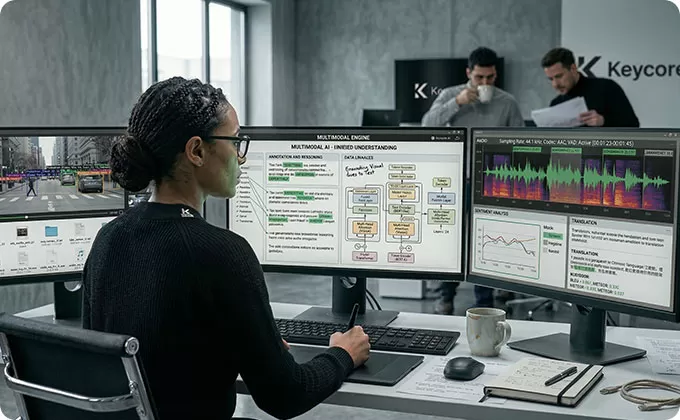

If your AI project requires high accuracy in a specialized domain, proprietary business scenarios, or unique edge cases, a custom AI dataset is usually the better investment. If your goal is to reduce development time, validate a concept quickly, or train models for common tasks, an off-the-shelf dataset often delivers the fastest and most cost-effective results.
The right choice depends on your data requirements, model objectives, regulatory constraints, budget, and deployment timeline. Many successful AI projects actually combine both approaches—starting with a public or commercial dataset and enriching it with custom-labeled data to improve domain-specific performance.
As foundation models become increasingly accessible, competitive advantage is shifting from algorithms to data quality. A high-quality machine learning training dataset determines how well an AI model generalizes, handles edge cases, and performs in real-world environments.
Poor-quality datasets often lead to:
Lower prediction accuracy
Increased bias
Weak generalization capability
More model retraining
Higher deployment costs
Whether you choose a ready-made dataset for AI training or build one from scratch, the dataset quality directly influences model performance throughout its lifecycle.
An off-the-shelf dataset is a pre-collected and pre-annotated dataset designed for common AI applications. These datasets are typically available through commercial providers or open-source repositories.
Typical applications include:
Computer vision
Speech recognition
Natural language processing
OCR
Facial recognition
Autonomous driving
Retail analytics
Since data collection and annotation are already completed, development teams can begin model training immediately.
Organizations avoid the high costs of recruiting participants, collecting raw data, and managing annotation projects.
Reputable providers implement quality assurance processes including:
Multi-stage annotation
Human review
Automated validation
Metadata verification
Commercial datasets often contain hundreds of thousands—or even millions—of labeled samples suitable for large-scale model training.
AI proof-of-concept projects
Benchmark testing
Academic research
General-purpose AI applications
Startups with limited budgets
A custom dataset is collected, annotated, and validated specifically for one organization's AI objectives.
Rather than relying on generic samples, every data point is designed to match the target environment.
Examples include:
Industrial defect detection
Medical imaging
Financial document processing
Manufacturing inspection
Agricultural monitoring
Retail shelf analytics
Insurance claims automation
Custom datasets often include:
Proprietary data
Domain-specific annotations
Customized labeling taxonomy
Unique environmental conditions
Business-specific edge cases
| Factor | Off-the-Shelf Dataset | Custom Dataset |
|---|---|---|
| Development Speed | Very fast | Longer preparation time |
| Initial Cost | Lower | Higher |
| Data Ownership | Usually licensed | Fully owned |
| Customization | Limited | Complete |
| Domain Relevance | General | Highly specific |
| Competitive Advantage | Moderate | High |
| Annotation Schema | Standard | Fully customized |
| Long-term Value | Limited | Strategic asset |
| Regulatory Control | Depends on provider | Fully manageable |
Neither option is universally superior.
Model accuracy depends on how closely the training data matches the production environment.
For example:
A generic image dataset may achieve excellent benchmark accuracy but perform poorly in:
Low-light warehouses
Factory production lines
Specialized medical imaging
Local language speech recognition
Custom datasets include exactly these real-world scenarios, allowing models to learn the patterns they will encounter after deployment.
Many enterprise AI projects experience significant accuracy improvements after introducing domain-specific data into the training pipeline.
Building your own dataset is worthwhile when:
Examples include:
Industrial sensors
Medical records
Financial transactions
Satellite imagery
Manufacturing defects
Generic datasets simply cannot represent these scenarios adequately.
Industries such as healthcare, finance, and government often require strict control over:
Data sources
Consent management
Privacy protection
Annotation workflows
Audit trails
Custom collection provides greater transparency and governance.
Examples include:
Rare defect detection
Predictive maintenance
Drug discovery
Legal document analysis
General datasets typically contain too few relevant examples.
Commercial datasets are ideal when:
You need rapid deployment
Budget is limited
The application is common
Benchmark performance is sufficient
You are validating product-market fit
Examples include:
OCR development
Face detection
Generic object recognition
Speech transcription
Chatbot intent classification
These datasets reduce project risk while accelerating experimentation.
Yes—and this is often the most effective strategy.
A common workflow includes:
Start with a large commercial dataset.
Pre-train the model.
Collect proprietary data from real operations.
Perform custom annotation.
Fine-tune using business-specific examples.
Continuously expand the dataset based on production feedback.
This hybrid approach balances development speed with long-term model performance.
Benefits include:
Lower initial costs
Faster MVP development
Better domain adaptation
Improved robustness
Continuous model optimization
Look for:
Annotation consistency
Low error rates
Clear labeling guidelines
Balanced class distribution
The dataset should include:
Edge cases
Rare scenarios
Different environments
Multiple demographics
Device diversity
Can the dataset grow alongside your AI application?
Future expansion should be considered from the beginning.
Review:
Commercial usage rights
Redistribution permissions
Geographic restrictions
Data ownership
Ensure the dataset aligns with applicable privacy and industry regulations.
High-quality data generally has a greater impact on model performance than simply increasing dataset size.
Characteristics of a reliable machine learning training dataset include:
Accurate annotations
Representative sampling
Diverse scenarios
Consistent labeling standards
Regular quality audits
Comprehensive metadata
Even sophisticated AI models cannot compensate for inaccurate or biased training data.
The best dataset for AI training depends on your objectives. Custom datasets generally provide higher accuracy for specialized applications, while off-the-shelf datasets are ideal for rapid development and standard use cases.
Yes. Many organizations pre-train or fine-tune models using commercial datasets before adding proprietary data to improve performance in specific domains.
Yes, especially for common AI tasks. However, enterprise applications with unique workflows often benefit from additional custom data to improve accuracy and reduce domain-specific errors.
There is no universal size requirement. The optimal dataset depends on task complexity, data diversity, annotation quality, and model architecture. A smaller, high-quality dataset can outperform a much larger but poorly labeled one.
Choosing between a custom AI dataset and an off-the-shelf dataset is not simply a matter of cost—it is a strategic decision that shapes model accuracy, scalability, compliance, and long-term competitive advantage.
Off-the-shelf datasets help organizations accelerate development and reduce upfront investment, making them ideal for standard AI applications and early-stage projects. Custom datasets, on the other hand, provide the domain-specific precision required for mission-critical systems where real-world performance matters most.
For many enterprises, the most effective approach is a hybrid strategy: begin with a trusted commercial dataset to shorten development time, then enhance it with proprietary, high-quality data that reflects your unique business environment. This combination enables faster deployment while delivering the accuracy and reliability needed for production AI.
As AI continues to evolve, organizations that invest in high-quality, purpose-built data will be better positioned to develop models that are not only technically capable but also aligned with real operational needs.